

Medically Reviewed By: Dr Samiullah Kundi, MD, Board-Certified Physician
Disclaimer:
The information, including but not limited to text, graphics, images, and other materials found on this page, is for educational and informational purposes only. No material on this site is intended to serve as a substitute for professional medical advice, clinical diagnosis, or specialized treatment.
Constant physical discomfort drains your energy completely. But when your mind is also firing on all cylinders, it genuinely feels like your own nervous system is actively working against you. You end up staring at the ceiling at 3 AM with rock-hard shoulder muscles, a racing pulse, and a quiet sense of dread that never quite goes away. The most frustrating part? Dealing with all of this while your doctor tells you your X-rays and MRI scans look perfectly “normal.”
If you are stuck in this frustrating loop, you aren’t imagining things. The relationship between chronic pain and anxiety disorder is very real, and it is entirely rooted in your biology.
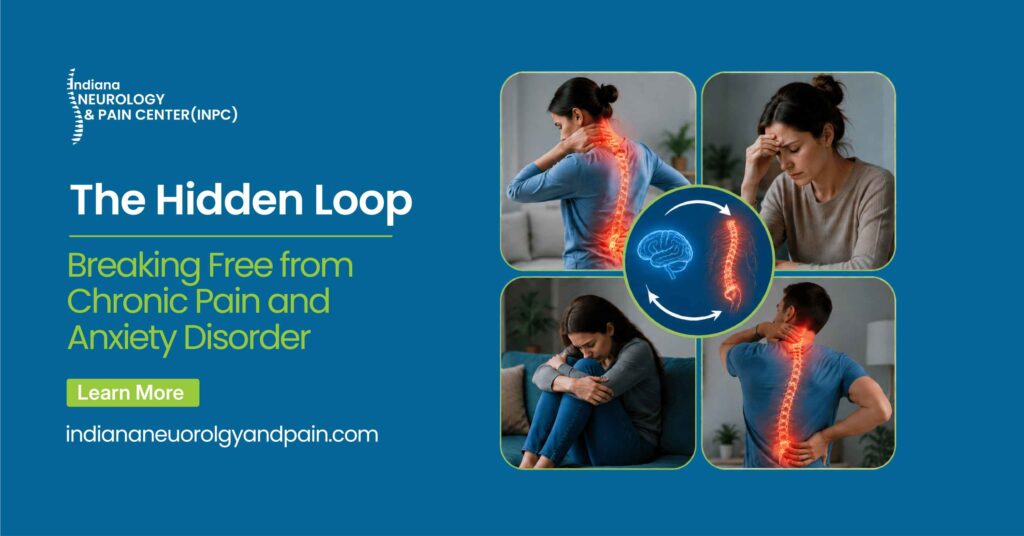
When your body hurts for a long time, your brain essentially gets stuck in survival mode. It starts treating everything as a threat, making you incredibly sensitive to anxiety, physical discomfort, and stress. Over time, these two conditions feed off each other. The more you hurt, the more anxious you feel; the more anxious you feel, the more you hurt.
The good news? You can actually break this cycle. With a holistic approach to pain care, physical rehab, and mental health support, you can train your nervous system to stand down. Here is a look at why anxiety chronic pain team up, and what modern medicine suggests you can do to find real relief.
Why Do Chronic Pain and Anxiety Disorder Go Hand in Hand?
It helps to think of the brain and body as a single, highly sensitive alarm system.
Both physical pain and fear are processed in the same area of the brain—specifically, a tiny almond-shaped structure called the amygdala. According to research from the National Institutes of Health (NIH), when you are in pain for months or years, this alarm system never gets to shut off. It becomes hyper-reactive.
Doctors call this central sensitization. Basically, your nervous system turns its volume dial all the way up. In this state, a normal physical sensation (like your stomach digesting or a slight change in temperature) can register as intense pain. Because your body thinks it is under attack, it ramps up your emotional stress, creating the perfect storm for chronic pain and anxiety disorder to take root.
Translating Your Body’s Signals
Here is a breakdown of what you might feel physically, how it impacts your mental state, and what is actually happening beneath the surface:
| Physical Sensation | Emotional Impact | The Hidden Biological Cause |
|---|---|---|
| Tingling nerves | Panic and anxiety | Sensitized nerves are “misfiring” and sending false alarm signals to the brain. |
| Muscle bracing | Hyper-vigilance | Your body is physically preparing to fight off a perceived threat. |
| Tightness in the chest | A deep sense of dread | The “fight-or-flight” response is restricting your breathing patterns. |
| Widespread, dull aches | Complete burnout and exhaustion | Your system has depleted its natural “feel-good” chemicals, like serotonin. |
| Sudden, sharp spasms | Acute, sudden stress | Electrical “shocks” are running through overly sensitive neural pathways. |
Spotting the Symptoms: Is It Pain, Anxiety, or Both?
When anxiety and chronic pain overlap, it’s incredibly hard to tell where the physical injury stops and the mental toll begins. This isn’t just everyday stress. It is a full-body reaction where you are perpetually braced for impact.
If your autonomic nervous system is stuck in fight-or-flight mode, it shows up in ways you might not even realize. See if any of these sound familiar:
- Subconscious Tension: You catch yourself clenching your jaw, lifting your shoulders up to your ears, or tightening your stomach without meaning to.
- Traveling Pain: You get weird zaps, aches, or tingling that jump from your leg to your back, to your arm—without any new injury to explain it.
- The Fear Factor: You start avoiding dinners out, hobbies, or specific movements simply because you are terrified they might trigger a flare-up.
- The Catastrophe Trap: The moment your pain level ticks upward, your brain immediately tells you, “This is permanent, I’m never going to get better.”
- Sensory Overload: Things like bright lights, loud noises, or an uncomfortable shirt actually make your physical pain feel sharper.
- Stress Hangovers: You notice that your body hurts significantly more a day or two after an emotional argument or a stressful week at work.
How Doctors Diagnose the Invisible
Getting a diagnosis for co-occurring conditions can be a bumpy road. As mentioned earlier, standard imaging tests (like MRIs or X-rays) are looking for structural damage—like a broken bone or a torn ligament. They cannot take a picture of an overactive nervous system.
A specialized pain physician or psychologist looks past the scans. According to resources from the Mayo Clinic, true diagnosis involves treating your sleep patterns, mood, stress levels, and daily habits as vital signs. If your doctor isn’t asking you about how you are sleeping or how you are feeling emotionally, it might be time to seek out a specialist who understands the mind-body connection.
Resetting Your System: Treatments That Actually Work
Treating a nervous system that is stuck on high alert requires a team approach. You can’t just treat the anxiety and ignore the back pain, and you can’t just ice a knee while ignoring the panic attacks. Here is what an effective, integrated treatment plan looks like.
1. Conservative Care: Rewiring the Brain and Body
Before jumping to extreme measures, doctors usually start by helping your nervous system cool down naturally.
- Cognitive Behavioral Therapy (CBT): CBT is a highly structured, evidence-based therapy recommended by the American Psychological Association (APA). It teaches you how to catch and stop the catastrophic thoughts that make your pain worse. By lowering the emotional threat level in your brain, your physical pain actually decreases.
- Specialized Physical Therapy: This is vastly different from a grueling gym workout. Graded Motor Imagery (GMI) or specific PTs are slowly bringing movement back to your body. We want to make movement easier and gently rebuild your mobility without creating a pain flare.
2. Interventional Procedures: Buying You Time
Sometimes, your pain levels are simply too high to even think about doing physical therapy or sitting through a CBT session. When the pain is unbearable, doctors can use targeted procedures to quiet the noise.
- Nerve Blocks & Radiofrequency Ablation: These aren’t magic cures, but they are incredibly useful tools. By temporarily numbing a specific nerve or interrupting a pain signal, doctors can lower your overall “pain load.” This gives you a crucial window of relief so you can actually participate in the therapies that lead to long-term healing.
3.Medication: Non-Narcotic Support for Chronic Pain and Anxiety Disorder
While opioids used to be the go-to for chronic pain, modern medicine leans heavily toward medications that stabilize the nervous system without the high risk of addiction.
| Type of Medication | The Main Goal | How It Actually Works |
|---|---|---|
| Nerve Stabilizers | Calm the overactivity | Stops overly sensitive nerves from misfiring and sending junk signals to the brain. |
| SNRIs and SSRIs | Balance the brain chemicals | Boosts neurotransmitters (like serotonin) that regulate mood and pain perception. |
| Muscle Relaxants | Release physical tension | Breaks the cycle of unconscious muscle guarding and bracing caused by severe anxiety. |
| Topical Agents | Numb the surface | Desensitizes specific areas of the skin to lower the amount of sensory data flooding into the brain. |
A Final Thought on Moving Forward

Dr. Samiullah Kundi
Pain medicine & Neurologist
Dr Kundi is a board-certified neurologist with rigorous medical training and pain management expertise. Mr. Kundi has been certified by the American Board of Pain Medicine (ABPM), American Board of Psychiatry and Neurology (ABPN) – Clinical Neurophysiology American Board of Integrative Holistic Medicine (ABIHM), and American Board of Psychiatry and Neurology (ABPN) – Neurology. Dr. Kundi’s vision of serving people with neurological pain has led to the establishment of the Indiana Neurology and Pain Management Centre.
Frequently Asked Questions
An MRI only shows the structure of your body (the hardware). It doesn’t show how your nervous system is processing signals (the software). In cases of chronic pain and anxiety disorder, the “software” is overreacting, sending massive pain signals to the brain even when the “hardware” is perfectly fine.
Absolutely. It can feel draining when you live with constant pain. Your body is burning an immense amount of energy just trying to manage the false threat signals. Fatigue is one of the most common—and valid—symptoms.
Yes, it can make a massive difference. By treating the anxiety, you pull your nervous system out of its hyper-alert state. When your brain no longer feels threatened, it stops amplifying the pain signals from your body.