

Date : 07/18/2026
Medically Reviewed By: Dr. Samiullah Kundi, MD, Board-Certified Physician
Disclaimer: The information provided on this page is for educational and informational purposes only and is not intended as a substitute for professional medical advice, diagnosis, or treatment. Always seek the advice of your physician or other qualified healthcare provider with any questions you may have regarding a medical condition or treatment plan.
Table of Contents
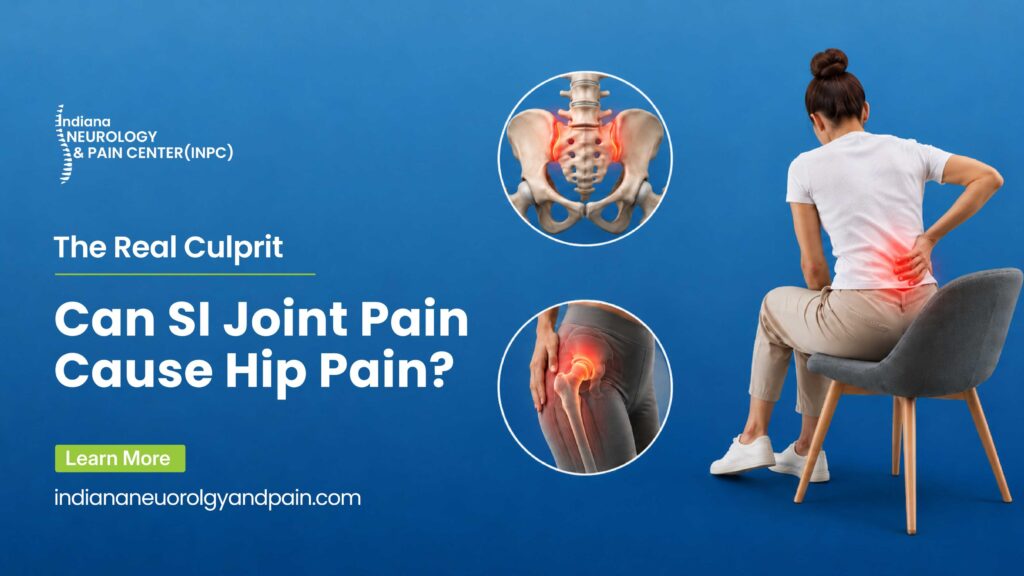
Living with chronic lower body ache is incredibly frustrating. You point to your hip. You assume the joint itself is failing. Yet, the true source of that agony often sits entirely elsewhere. Bodies are tricky. Nerves send distress signals across wide areas, which makes getting an accurate diagnosis incredibly tough. So, can SI joint pain cause hip pain? Yes, it absolutely can. In fact, orthopedic doctors see this specific misdiagnosis constantly.
Patients often spend months pursuing the wrong treatment plan. They rest. They stretch. They get steroid shots in the hip socket. Nothing works. The frustration builds because the fundamental mechanics of the body are being ignored. To actually fix the problem, you have to look higher up the chain. You have to look at the pelvis.
The Foundation of the Pelvis
Think about the pelvis as the structural foundation of a house. The sacroiliac (SI) joints link the sacrum—the bone at the very base of the spine—directly to the iliac bones. The hip joint swings freely to let you run and walk. The SI joint does not. It acts strictly as a heavy-duty shock absorber.
A massive web of incredibly tight ligaments locks the SI joint down. It only glides a few millimeters. Its singular job is to take the entire weight of your upper body and shove it safely down into your legs.
Things go wrong when those ligaments fail. They might stretch out from a sudden impact. They loosen up naturally during pregnancy. Sometimes they freeze solid because of inflammatory arthritis. When the joint stops absorbing shock, everything surrounding it panics. People stuck in this miserable situation frequently ask, “Can SI joint cause hip pain without showing up on a standard hip X-ray?” They ask this because the nerves wrapped around the SI joint share the exact same sensory highways that run down into the groin and upper thighs. The wires get crossed.
The Misguided Signals
Nerve inflammation creates what doctors call referred pain. The brain misreads the distress signal. It thinks the hip is screaming when the lower spine is actually the one on fire. This is why SI joint and hip pain almost always show up together.
It becomes a domino effect. If a painful lower back makes someone change how they walk, that uneven, limping stride grinds against the actual hip socket. Over weeks and months, that secondary friction creates severe joint inflammation. Mechanical wear and tear is impossible to dodge when you drastically change your natural gait. That physical reality is exactly why individuals start researching can SI joint pain cause hip pain after conservative treatments for their hip completely fail them.
Recognizing the True Origin
How do you tell them apart? Look at where the ache actually starts. True hip socket issues usually create a deep, nasty grind right in the front groin crease. Putting on socks hurts. Pivoting hurts.
SI joint problems act differently. The ache typically wakes up in the lower back or right at the top of the buttocks. A major red flag is experiencing SI joint pain radiating to hip areas. The ache travels down the outside of the thigh. Sometimes it wraps around the front pelvic bone. It rarely shoots past the knee. That specific stopping point helps separate it from standard sciatica caused by a blown spinal disc.
Muscle tightness tells a story too. Experiencing severe SI joint pain hip flexor tightness is extremely common. The psoas muscle attaches the lumbar spine directly to the pelvis. When the SI joint gets wobbly and unstable, the psoas violently clamps down. It tries to act like a makeshift splint to hold the bones together. That creates intense, unrelenting tension right at the front of the pelvis.
| Symptom Location | Primary Hip Joint Issue | Sacroiliac (SI) Joint Issue |
|---|---|---|
| Focal Point | Deep inside the front groin. | Lower back or upper buttock. |
| Pain Path | Inner thigh down to the knee. | Outer thigh, wrapping the pelvic crest. |
| Physical Triggers | Crossing legs, pivoting, walking. | Standing up from a chair, rolling over in bed. |
| Sensation | Catching or stiff grinding in the socket. | Sharp stabbing upon movement, dull lower back ache. |
The Diagnostic Challenge: Can SI Joint Pain Cause Hip Pain?
Doctors rely heavily on physical stress tests to figure this out. X-rays and MRIs are tricky tools. They frequently highlight mild arthritis in joints that aren’t actually causing the patient any active grief. Finding the true pain generator requires a hands-on approach. A specialist will deliberately twist, push, and pull the legs to see if they can trigger the exact same pain the patient deals with daily.
If the physical tests point heavily to the pelvis, the final step is usually a diagnostic block. A physician uses an X-ray to inject a strong numbing agent right into the SI joint. It provides immediate, undeniable answers. Does the hip pain completely vanish while the pelvis is numb? If yes, the lower spine is the confirmed culprit.
| Diagnostic Test | What It Involves | What It Proves |
|---|---|---|
| Fortin Finger Test | Pointing to the exact center of the pain with one single finger. | Pointing directly to the PSIS bone strongly signals SI dysfunction. |
| FABER Test | Flexing and rotating the leg while lying completely flat. | Stresses both joints simultaneously to isolate the pain source. |
| Guided Injection | Injecting numbing medication directly into the SI joint via X-ray. | If numbing the pelvis entirely stops the hip pain, the SI joint is the target. |
The Mechanics of Breakdown
Let’s talk about physical stress. The pelvis connects the top half of your body to the bottom half. Hip pain from SI joint dysfunction happens simply because of mechanical overload.
When the pelvis is hypermobile (too loose), the surrounding muscles panic. The glutes, piriformis muscles, and hip flexors work overtime to hold the skeletal structure together. They get exhausted. This leads to chronic tendinitis. The piriformis muscle, which runs from the sacrum to the outer hip, often spasms so hard it chokes the sciatic nerve.
When the joint suffers from hypomobility (too stiff), the lower spine and the hip socket have to absorb twisting forces they were never meant to handle. This shreds the hip cartilage over time. Identifying SI joint related hip pain symptoms requires looking at the whole kinetic chain, rather than just staring at the isolated area that hurts.
Finding Relief: Can SI Joint Pain Cause Hip Pain?
Treatment only works when it targets the real problem. Trying to fix an SI joint by heavily medicating the hip is pointless. When patients ask their physical therapists Can sacroiliac joint cause hip pain, they are often surprised by the answer. Therapy usually starts by focusing heavily on fixing pelvic tilt. Therapists work to make the core and glutes incredibly strong so they can support the failing joint. A trochanteric belt is another simple but massive help. It is a rigid brace worn tightly around the hips that literally squeezes a loose pelvis together, offering immediate relief.
If therapy isn’t enough, intervention becomes necessary. Doctors often look at corticosteroid injections to calm the angry, inflamed joint. Radiofrequency ablation (RFA) goes a step further. It uses heat to burn the specific sensory nerves, shutting off the pain signals to the brain for up to a year. For joints that stubbornly refuse to stabilize, a minimally invasive surgical fusion permanently stops the grinding movement by locking the bones together.
Securing the Right Diagnosis

Dr. Samiullah Kundi
Pain medicine & Neurologist
Dr Kundi is a board-certified neurologist with rigorous medical training and pain management expertise. Mr. Kundi has been certified by the American Board of Pain Medicine (ABPM), American Board of Psychiatry and Neurology (ABPN) – Clinical Neurophysiology American Board of Integrative Holistic Medicine (ABIHM), and American Board of Psychiatry and Neurology (ABPN) – Neurology. Dr. Kundi’s vision of serving people with neurological pain has led to the establishment of the Indiana Neurology and Pain Management Centre.
Frequently Asked Questions
Absolutely. A failing sacroiliac joint throws off the mechanics of the entire lower body. The hip muscles and the ball-and-socket joint have to drastically compensate for the pelvic instability. This physical overload creates severe, localized ache that perfectly mimics a primary hip injury.
Hip joint issues typically cause deep groin pain that gets worse when walking, pivoting, or tying shoes. SI joint problems usually start in the lower back or upper buttocks. The pain severely spikes when standing up from a seated position or trying to roll over in bed.
No. Injecting steroids into a hip socket only lowers the active inflammation inside that specific capsule. It does absolutely nothing for a failing SI joint. If a hip injection fails to provide relief, doctors usually immediately pivot to checking the pelvis.
When the pelvis is unstable, the hip flexor muscles involuntary spasm to try and hold the bones together. This constant, exhausting tension creates severe aching in the front of the thighs and groin, confusing the diagnosis further.
The piriformis attaches the lower spine to the top of the thigh bone. When the SI joint fails, this muscle tightens up to stabilize the area. Because it sits right on top of the sciatic nerve, a tight piriformis sends shooting pain down the back of the leg, mimicking both hip and spine issues.