

Medically Reviewed By: Dr. Samiullah Kundi, MD, Board-Certified Physician
Disclaimer: The information provided in this article is for educational and informational purposes only and does not constitute medical advice. It is not intended to be a substitute for professional medical diagnosis, treatment, or guidance. Always seek the advice of a physician or other qualified healthcare provider with any questions regarding a medical condition or treatment plan.
Taking a load off is supposed to be relaxing. You finally sink into your office chair, slide into the driver’s seat, or crash on the couch after a brutally long day. That moment should bring instant relief. But lately? It just brings more pain.
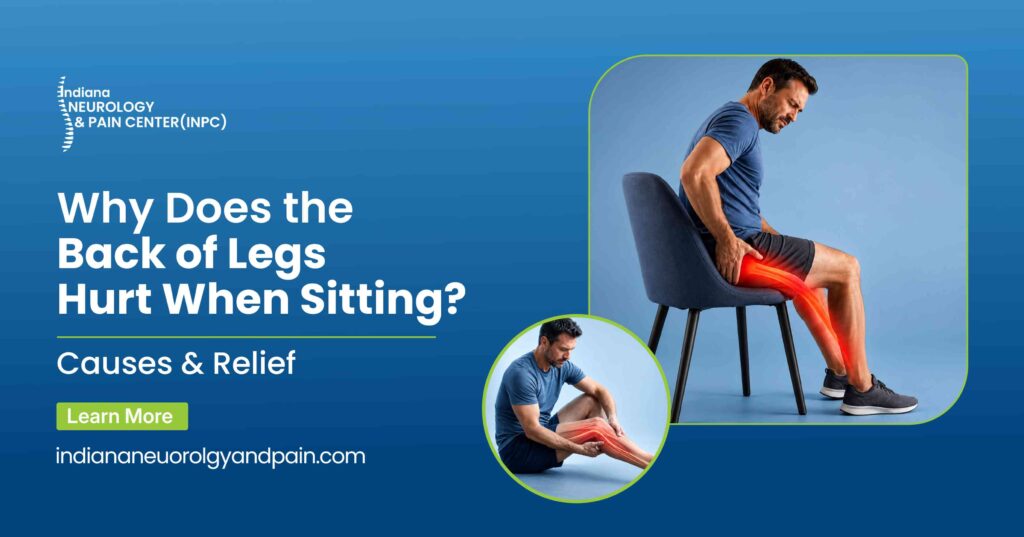
If you are constantly shifting your weight, squirming, or standing right back up because the back of legs hurt when sitting, you are certainly not alone. This specific, maddening type of discomfort ruins productivity and turns basic relaxation into a frustrating ordeal. Living with chronic or sudden sharp pain in the lower extremities feels incredibly isolating. Yet, it happens to be a highly common—and highly treatable—symptom linked to various musculoskeletal and neurological conditions.
Usually, the problem is within the complex, interconnected web of nerves, muscles, and blood vessels running from the lower back, straight through the pelvis, and down into the thighs. This comprehensive guide breaks down the exact medical reasons behind posterior leg pain when sitting, the warning signs that warrant professional medical attention, and the advanced therapies available to help patients reclaim their comfort.
Biomechanics: Why Back of Legs Hurt When Sitting
To figure out why resting in a chair triggers so much discomfort, you just have to look at how the human body handles gravity.
The very second a person sits down, a massive chunk of their upper body weight shifts directly onto the pelvis.
More specifically, this weight bears down on the ischial tuberosities—commonly known as the “sit bones.” This position aggressively compresses the gluteal muscles. It also ramps up the pressure on the lumbar spine.
For someone with perfect spinal health and loose muscles, this is rarely an issue. However, if there is underlying spinal instability, a deeply inflamed nerve, or chronic muscle tightness, the simple act of sitting acts as an immediate trigger. Intradiscal pressure in the lower back is actually significantly higher when sitting compared to standing. So, if a nerve is already compromised, the physical force of a chair pressing against the back of the thighs only magnifies the irritation. The end result? Severe, radiating pain in back of the legs when sitting.
5 Culprits Behind Pain in the Back of Legs While Sitting
Pinpointing the exact root of the problem is always the first step toward actual relief. Several distinct medical issues frequently cause pain in the back of the leg while sitting.
| Possible Culprit | Where It Hurts the Most | What the Pain Feels Like | The Sitting Trigger |
|---|---|---|---|
| Sciatica / Radiculopathy | Lower back traveling down through the calf to the foot. | Sharp, burning, electrical jolts, or tingling/numbness. | Sitting compresses the lumbar spine, pushing discs directly into the spinal nerves. |
| Hamstring Strain | The back of the thigh (muscle belly). | Deep, stubborn ache or extreme muscle tightness. | The hard edge of the chair presses directly into inflamed muscles and tendons. |
| Piriformis Syndrome | Deep within the buttocks and upper thigh. | Intense aching that mimics sciatica. | Prolonged sitting causes the piriformis muscle to spasm and clamp down on the sciatic nerve. |
| Ischial Bursitis | Right under the buttock at the “sit bone.” | Highly localized, dull aching. | Sitting on hard, unforgiving surfaces inflames the fluid-filled bursa sac. |
| Vascular Issues (DVT/PAD) | Throughout the whole leg or calf. | Throbbing, swelling, or accompanied by visible heat/redness. | Staying immobilized allows blood to pool, causing poor circulation. |
1. Sciatica and Lumbar Radiculopathy
Ask any spine specialist, and they will point to sciatica as the most frequent offender for pain shooting down the back of the leg. The sciatic nerve happens to be the longest and thickest nerve in the human body. It starts in the lower back, branches down through the buttocks, and travels down the back of both legs.
When spinal stenosis, a rogue bone spur, or a herniated disc compresses nerve roots in the lumbar region, lumbar radiculopathy develops. Because taking a seat spikes pressure on spinal discs, it often forces a bulging disc even further into the spinal canal. This pinches the sciatic nerve directly. Patients typically describe the resulting pain in the back of the legs as a sharp, burning, or electrical shock sensation, which often travels alongside tingling in the foot.
2. Hamstring Tendinopathy or Strains
The hamstrings consist of three distinct muscles running down the back of the thigh. Runners, athletes, or anyone who recently pushed their physical limits might be dealing with a localized hamstring strain.
When seated, the hard edge of a chair presses right into these muscles and their connecting tendons. This could be the reason why your back of legs hurt when sitting. If chronic micro-tears or inflammation exist in those tendons, sitting provokes severe hamstring pain when sitting. Unlike the burning, electrical jolts of nerve damage, this usually feels like a deep, stubborn ache or extreme tightness.
3. Piriformis Syndrome
Deep inside the buttocks lies a small muscle called the piriformis. It sits dangerously close to the sciatic nerve—in fact, for some people, the nerve runs right through the muscle. If this specific muscle goes into spasms or tightens up due to prolonged sitting, it clamps down on the sciatic nerve.
The resulting symptoms perfectly mimic traditional sciatica. It generates an intense pain behind legs when sitting, usually localized deep within the glute and upper thigh area.
4. Ischial Bursitis (The “Weaver’s Bottom”)
Bursae are tiny, fluid-filled sacs. They do the heavy lifting of cushioning the friction between bones and soft tissues. The ischial bursa rests perfectly between the gluteus maximus muscle and the sit bone.
Sitting on unforgiving, hard surfaces for hours on end eventually inflames this bursa. Historically dubbed “weaver’s bottom,” this condition triggers a highly localized, aching pain in the back of the upper thigh under the buttock. The longer the sitting session lasts, the worse the aching becomes.
5. Vascular Complications (PAD or DVT)
Though slightly less common as a direct trigger tied specifically to the posture of sitting, poor blood circulation absolutely causes leg pain. Peripheral Artery Disease (PAD) usually hurts worse when walking, but staying seated for hours allows blood to pool, causing swelling and throbbing. This could be the reason why the back of legs hurt when sitting.
More alarmingly, staying immobilized in a chair for a long time increases the risk of developing Deep Vein Thrombosis (DVT)—a blood clot in the deep veins of the leg. If leg pain suddenly pairs with swelling, heat, or skin redness, immediate emergency medical intervention is required.
Recognizing When to See a Doctor
Certain minor aches fade with a better ergonomic chair and some stretching. If Other symptoms act as red flags that nerves or blood vessels are actively failing. A formal evaluation at Indiana Neurology and Pain Center is highly recommended if a patient experiences:
- Pain that refuses to subside after a week of rest and over-the-counter anti-inflammatories.
- “Pins and needles,” numbness, or tingling that physically spreads down into the calf or the toes.
- Sudden, unexplained muscle weakness in the leg that makes standing up or walking difficult.
- Visible heat, severe swelling, or deep redness in the affected leg.
- Any sudden loss of bowel or bladder control. (Note: This points to Cauda Equina Syndrome and requires emergency room care immediately).
Advanced Treatment: When the back of Legs Hurt When Sitting
Masking symptoms with endless medication is rarely a sustainable strategy. Treating the anatomical root cause of the pain is the standard of care. Depending on the precise diagnosis causing the pain in back of leg while sitting, treatment protocols at INPC often include:
Conservative and Physical Therapies
Mild hamstring strains and early-stage piriformis syndrome respond beautifully to conservative care. Targeted physical therapy builds core strength and stretches out tight hamstrings. This is often paired with alternating ice/heat therapy, topical analgesics, and specific anti-inflammatory regimens.
Interventional Pain Management Options
When pain stems from severe nerve compression—like an angry herniated disc or intense sciatica—state-of-the-art, minimally invasive interventions provide profound relief.
- Epidural Steroid Injections (ESIs): Instead of relying on daily pills that affect the whole body, this puts heavy-duty anti-inflammatory medicine exactly where the fire is—deep inside the spine. It physically washes out the proteins causing the flare-up. Once that localized swelling drops, the trapped nerve root finally gets the space it needs to heal.
- Targeted Nerve Blocks: Sometimes a specific nerve just will not stop firing. A block acts almost like a mute button. Specialists guide a precise injection right next to the angry lumbar branches, stopping those chaotic pain signals dead in their tracks so the brain never even registers the ache.
- Radiofrequency Ablation (RFA): Controlled heat is actually an incredible tool for stopping pain. This procedure uses targeted thermal energy to essentially quiet the tiny nerve fibers wrapping around aching spinal joints. By interrupting the transmission line, it cuts off the pain right at the source.
- Spinal Cord Stimulation (SCS): When sitting causes leg pain, it can be stubborn nerve issues. This long-term nerve damage occasionally needs a high-tech workaround. A small implanted device steps in to alter how the nervous system communicates. It actively intercepts severe pain signals along the spine before the brain ever gets a chance to process them.
Stop Letting Leg Pain Dictate Your Day

Dr. Samiullah Kundi
Pain medicine & Neurologist
Dr Kundi is a board-certified neurologist with rigorous medical training and pain management expertise. Mr. Kundi has been certified by the American Board of Pain Medicine (ABPM), American Board of Psychiatry and Neurology (ABPN) – Clinical Neurophysiology American Board of Integrative Holistic Medicine (ABIHM), and American Board of Psychiatry and Neurology (ABPN) – Neurology. Dr. Kundi’s vision of serving people with neurological pain has led to the establishment of the Indiana Neurology and Pain Management Centre.
Frequently Asked Questions
It all comes down to spinal pressure. Sitting increases the mechanical load on lumbar spinal discs by up to 40% compared to standing. If a disc is bulging, sitting actively squeezes it backward into the spinal nerves, triggering sciatica. Standing up and walking relieves that specific disc pressure, which is why movement brings relief.
Absolutely. An unsupportive chair forces the lumbar spine to slouch into an unnatural curve, which drastically exacerbates disc issues. Furthermore, if the seat pan is too high or features a hard front edge, it physically cuts off circulation and presses straight into the hamstring tendons. This directly leads to pain behind legs when sitting.
Telling the two apart is tricky. Generally speaking, a hamstring injury feels like a dull, extremely tight ache right in the muscle belly. It worsens if you actively try to bend your knee against resistance. Sciatica behaves differently; it usually features a sharp, burning, or electrical pain that radiates down from the lower back, frequently accompanied by numbness.
It all starts with fixing your daily workspace. Your feet actually need to be planted flat on the ground so your knees bend perfectly at a right angle. Do not skip using a lumbar pillow, either—it keeps the lower back from slouching into a painful curve. But the absolute best trick? Just getting up. Try setting a quick timer. Every 30 minutes, force yourself to stand and walk around for 30 seconds. Doing this instantly takes the crushing pressure off your spine and gets the blood flowing back into your leg muscles.