

Medically Reviewed By: Dr. Samiullah Kundi, MD, Board-Certified Physician
Disclaimer: This article is for educational purposes only and does not replace professional medical advice, diagnosis, or treatment. Always consult a qualified healthcare provider regarding any chronic pain or new symptoms. If you are experiencing a medical emergency, call 911 or go to the nearest emergency room immediately.
Let’s talk about chronic pelvic and lower back pain. It is exhausting. You already know the drill: waking up stiff, dreading a simple flight of stairs, shifting endlessly in your chair just to find a spot that doesn’t ache. When standard treatments like rest and physical therapy don’t cut it, you have to look deeper. Sometimes, the spine isn’t the problem at all. It’s your sacroiliac (SI) joint.
Reliable speciality clinics don’t just guess at your symptoms. They pinpoint them. If you are desperate for answers, we often use a highly specific tool called a lateral branch block. It helps us map out exactly where your pain originates so we can actually stop it.
What is a Lateral Branch Block?
Think of it as a diagnostic test drive. It’s a quick injection designed to temporarily shut down pain signals coming from the SI joint.
To see why this works, you need a quick anatomy lesson. Your lower back relies on the sacroiliac joints. They act as heavy-duty shock absorbers, bridging the gap between your sacrum (the tailbone area) and your ilium (the pelvic bones). These joints hardly move. Instead, they handle the massive mechanical stress of holding your upper body upright.
When an SI joint gets damaged or inflamed, it triggers an alarm. That alarm travels straight to your brain through a network of tiny, specific wires called the lateral branch nerves.
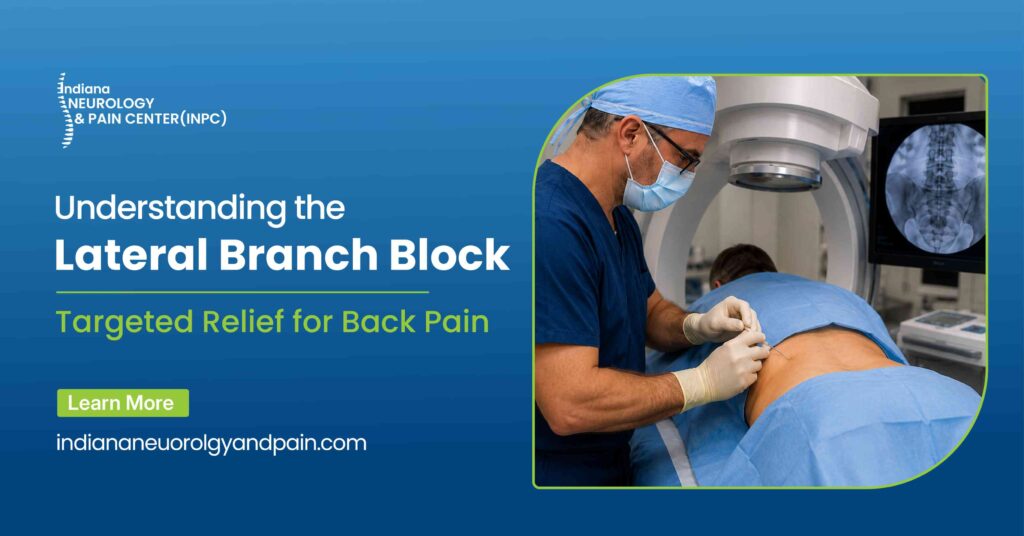
So, what do we do? A physician performs a sacral lateral branch block by placing a small drop of numbing medicine right next to those specific nerve pathways. By shutting the power off on those specific wires, we instantly know if the SI joint is the root cause of your agony.
Is a Sacral Lateral Branch Block Right for You?
Back pain is notoriously tricky to diagnose. The symptoms constantly overlap. That is why we look for specific clues before recommending a lateral branch block for back pain.
You might be the perfect candidate for a lateral branch nerve block if your day-to-day looks like this:
- A deep, biting ache isolated on one side of your lower back.
- Pain is anchored right in the middle of your hip or buttock.
- Radiating discomfort down the back of your leg—but crucially, it stops before reaching your knee.
- Sharp spikes of pain during transitions. Getting out of a car. Rolling over in bed.
- Standing makes it worse. Lying down makes it manageable.
If you are nodding your head, and anti-inflammatory pills aren’t making a dent, a sacroiliac lateral branch block is the logical next move.
The Lateral Branch Block Procedure: What to Expect
Let’s clear the air: procedure anxiety is totally normal. But the lateral branch block procedure is practically routine for our specialists. It happens right in the clinic, it’s fast, and it’s incredibly safe.
Before You Arrive
We will hand you a personalized prep list, but here is the golden rule: we need you hurting. If you take your heavy pain meds before the appointment, you mask the baseline pain. We need to measure exactly how much relief the lateral branch block injection provides, so skip the painkillers for a few hours before you walk through our doors.
The Walkthrough
- Getting Comfortable: You’ll lie face-down on a specialized X-ray table. We clean the lower back area and use a local numbing spray on your skin. You stay awake the whole time, though we can easily offer a mild, relaxing IV sedative if you’re feeling nervous.
- Live X-Ray Guidance: We rely on a real-time X-ray tool called fluoroscopy. Think of it as a live GPS tracking the needle. There is zero room for guesswork here. To be absolutely certain we are sitting right next to those sacral lateral branch nerves, we inject a tiny drop of contrast dye. When that dye lights up exactly where it should on the screen, we know the placement is locked in.
- The Numbing Agent: With the needle safely positioned, the actual medication goes in. The doctor releases a tiny amount of local anesthetic to bathe the nerve fibers. Because the SI joint receives pain signals from a few different branches, the professionals cannot just numb one isolated spot. They carefully treat the nerves along the S1, S2, and S3 sections of your sacrum so the entire pain network goes quiet.
- The Test Drive: The actual injection is over in about ten minutes. The specialist then has you hang out in recovery for half an hour. The real test? They will ask you to walk the halls or bend over—whatever usually hurts—to see if the pain vanished.
Heading Home
Because the numbing agent alters your reflexes, you aren’t getting behind the wheel. Bring a driver. We will send you home with a “Pain Diary.” The medicine wears off in a few hours, so tracking how you feel during that short window is the most important homework you will ever do.
The Results: Diagnostic vs. Therapeutic
Here is where patients get confused: a sacral lateral branch nerve block isn’t a permanent fix. It is a diagnostic roadmap. The numbness fades, and yes, your pain will probably return later that night.
But what happens during that brief pain-free window dictates everything else:
| How You Feel After the Injection | The Next Step in Your Treatment |
|---|---|
| The pain vanishes (or drops by at least 80%). | This is the exact green light we are looking for. It proves the SI joint is the problem, and you are officially cleared for Radiofrequency Ablation (RFA) to get long-term relief. |
| Your pain stays exactly the same. | This tells us the SI joint is completely fine. We won’t waste your time treating the wrong spot, and your doctor will immediately pivot to investigate your lumbar discs instead. |
Why Choose Indiana Neurology and Pain Center?

Dr. Samiullah Kundi
Pain medicine & Neurologist
Dr Kundi is a board-certified neurologist with rigorous medical training and pain management expertise. Mr. Kundi has been certified by the American Board of Pain Medicine (ABPM), American Board of Psychiatry and Neurology (ABPN) – Clinical Neurophysiology American Board of Integrative Holistic Medicine (ABIHM), and American Board of Psychiatry and Neurology (ABPN) – Neurology. Dr. Kundi’s vision of serving people with neurological pain has led to the establishment of the Indiana Neurology and Pain Management Centre.
Frequently Asked Questions
Expect the actual pain relief to last anywhere from 4 to 8 hours. Remember, it’s a test to confirm the pain source, not a permanent treatment.
It is incredibly tolerable. You’ll feel a quick sting from the skin numbing, followed by some weird, deep pressure as the medication goes in. That’s about it.
Location. An SI joint injection pushes steroids inside the joint to fight swelling. This branch block stays outside the joint, just numbing the sensory nerves carrying the pain signals.
No way. The numbing medicine can accidentally make your leg or hip feel a little weak or wobbly for a few hours. A friend or family member has to drive you.
Insurance companies and strict medical guidelines require a “double-block” process on two different days. It proves the first result wasn’t a fluke before we move on to the longer-lasting ablation procedure.