

Medically Reviewed By: Dr. Samiullah Kundi, MD, Board-Certified Physician
Disclaimer: This content is for informational and educational purposes only and does not constitute professional medical advice, diagnosis, or treatment. Always consult with a physician or qualified healthcare provider before starting any new exercise routine or if you have questions regarding a medical condition. Never disregard or delay seeking professional medical advice based on information provided here.
The ache usually starts deep. It sits heavy in the lower spine, creating a stubborn, grinding stiffness that makes simply getting out of bed feel like a monumental task. Then comes the shock.
Without warning, a jagged line of electrical pain fires down the back of your thigh and into your calf. It forces you to freeze completely until the burning sensation finally passes. Anyone dealing with this chaotic mix of joint stiffness and sudden nerve pain eventually ends up asking the exact same question: Can arthritis cause sciatica? The reality? Yes. It absolutely can.
While they are entirely distinct medical conditions, their relationship is incredibly close. In fact, age-related degeneration in the spine frequently creates a localized anatomical domino effect. A failing joint eventually leads to a pinched nerve.
Untangling how these two conditions overlap is the only way to stop treating just the symptoms and start addressing the actual root of the pain. This guide breaks down the mechanics of the spine, why the overlap happens, and exactly what modern medicine can do to quiet the nerves and stabilize the joints.
The Anatomy of the Pain
To understand the mechanics behind arthritis causing sciatica, you have to look closely at the architectural limits of the human spine. It comes down to space.
The Breakdown of the Joints
Arthritis is a massive umbrella term. When discussing back pain, physicians are almost always looking at osteoarthritis of the spine, clinically known as spondylosis.
Your spine is built from stacked vertebrae, linked together by facet joints. Those joints are lined with smooth cartilage to prevent friction. But cartilage doesn’t last forever. Years of repetitive lifting, old sports injuries, or simply gravity itself eventually wear that cartilage down.
When the protective lining vanishes, bone rubs directly against bone. The body hates instability. To stop the grinding, it attempts to reinforce the failing joint by growing tiny, jagged new bone formations. Doctors call these osteophytes. Most people just call them bone spurs.
The Vulnerability of the Nerve
Sciatica, on the other hand, is not a disease. It is a symptom.
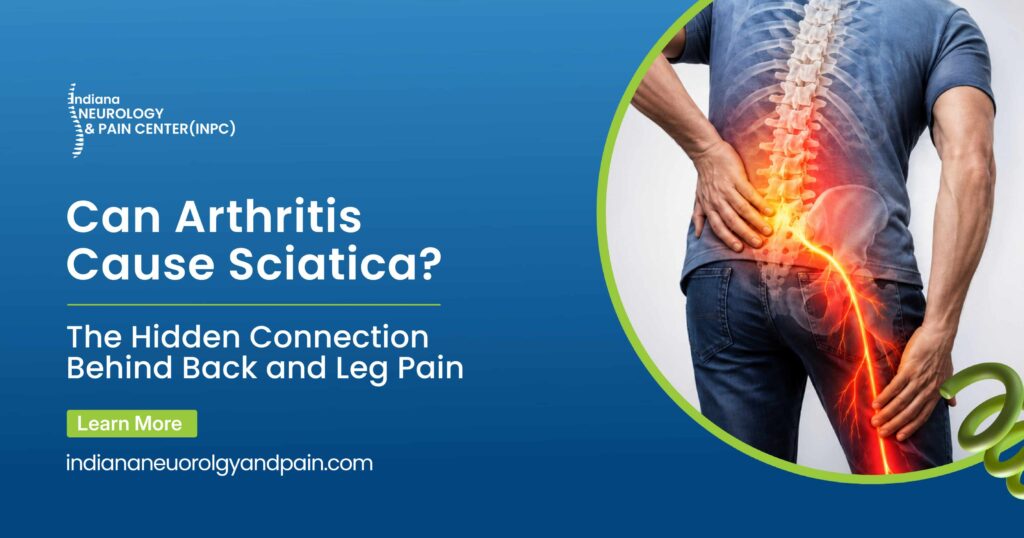
The sciatic nerve is a massive bundle of fibers. It is the thickest nerve in the human body. It starts as several smaller nerve roots exiting the lower lumbar spine, which then merge and travel deep beneath the gluteal muscles, running all the way down the legs.
When something—anything—pinches one of those root nerves in the lower back, it triggers an alarm system. That alarm manifests as a searing, radiating pain, often accompanied by numbness or a feeling like tiny needles pricking the foot.
The Collision Point: When Two Conditions Merge
Can you have arthritis and sciatica at the same time? It happens every single day. The structural changes driven by lower back arthritis and sciatica are locked together by the tight confines of the spinal canal.
Remember those bone spurs the body grows to stabilize an arthritic joint? They take up room. The spaces where the nerve roots exit the spinal cord are already incredibly narrow. When bone spurs expand into those tiny exit pathways—a structural issue known as foraminal stenosis—the nerve has nowhere to go.
The expanding bone violently compresses the sensitive nerve tissue. This direct mechanical crushing is the literal definition of sciatica caused by arthritis. The joint deteriorated first. The nerve paid the price.
Decoding the Signals: Can Arthritis Cause Sciatica?
Patients trapped dealing with spinal arthritis and sciatica are often overwhelmed by the sheer variety of their symptoms. Because everything radiates from the lower back, separating the structural ache from the neurological fire is tough.
Here is how the pain profiles differ:
| Feature | Spinal Arthritis (Joint Pain) | Sciatica (Nerve Pain) |
|---|---|---|
| Type of Pain | Dull, heavy, grinding, or throbbing ache. | Sharp, burning, electrical, or shooting pain. |
| Location | Highly localized; stays centered right in the lower lumbar region. | Travels; shoots from the lower back down one specific leg (thigh/calf). |
| Common Triggers | Standing perfectly still for too long, bending backward, or waking up in the morning. | Sneezing, coughing, laughing, or trying to walk/climb stairs. |
| Methods of Relief | Sitting down or leaning forward (like over a shopping cart). | Usually requires medical intervention, rest, or finding a highly specific pain-relieving posture. |
| Associated Symptoms | Severe joint stiffness that slowly loosens up after walking. | Profound numbness, “pins and needles,” or sudden muscle weakness in the leg. |
When a patient presents with arthritis with sciatica symptoms, the clinical picture is layered. They might struggle to tie their shoes due to lower back stiffness, but then feel a violent, radiating burn the moment they try to walk down the driveway. Treating just the nerve inflammation while ignoring the grinding joints ensures the pain will simply return next month.
Achieving an Accurate Diagnosis
Can arthritis cause sciatica? Guesswork has no place in spine health. Because arthritis and sciatic nerve pain mimic other severe issues—like a ruptured disc or deep muscle spasms—precise imaging is mandatory.
Physicians start with physical neurology tests. If lying flat and having a doctor raise your straight leg into the air triggers the familiar shooting pain, nerve compression is highly probable.
From there, imaging takes over. Traditional X-rays are excellent at spotting the bone spurs and decreased joint space that define osteoarthritis. However, X-rays cannot see soft tissue. To definitively prove arthritis related sciatica, a high-resolution MRI is required. An MRI visually maps the exact millimeter where a bone spur is crushing the sciatic nerve root. If neurological damage is suspected to be severe, an Electromyography (EMG) test might be ordered to measure how slowly electrical signals are moving through the damaged nerve.
Beyond the Diagnosis: Can Arthritis Cause Sciatica and How Do You Stop It?
Stopping the pain requires a dual approach. You have to put out the neurological fire while simultaneously stabilizing the degenerating joints.
Conservative Rehabilitation
Immediate treatment almost always avoids the operating room. Non-invasive protocols focus on function.
- Targeted Physical Therapy: This is not generic stretching. Specialized physical therapy strengthens the deep core muscles that act as an internal corset for the spine, pulling pressure off the crushed nerves.
- Strategic Medication: Over-the-counter anti-inflammatories calm the joint. Prescription muscle relaxants stop the surrounding tissues from violently spasming. In severe cases, specific medications designed to disrupt nerve pain signals (like gabapentin) are utilized to let the patient sleep.
Interventional Precision
When physical therapy hits a wall, interventional procedures step in.
- Epidural Steroid Injections: Guided by live fluoroscopic X-rays, a powerful anti-inflammatory medication is washed directly over the pinched sciatic nerve. This can silence the radiating leg pain for months.
- Radiofrequency Ablation: If the arthritic facet joints are screaming, an advanced procedure can use controlled thermal energy to temporarily disable the tiny sensory nerves carrying the joint pain signals to the brain.
Surgical Decompression
Surgery is strictly reserved for worst-case scenarios. If the leg becomes dangerously weak, or if the pain simply refuses to break after months of intervention, structural correction is necessary. Procedures like a laminectomy manually shave away the encroaching bone spurs, physically freeing the nerve and permanently resolving the compression.
The Path Forward

Dr. Samiullah Kundi
Pain medicine & Neurologist
Dr Kundi is a board-certified neurologist with rigorous medical training and pain management expertise. Mr. Kundi has been certified by the American Board of Pain Medicine (ABPM), American Board of Psychiatry and Neurology (ABPN) – Clinical Neurophysiology American Board of Integrative Holistic Medicine (ABIHM), and American Board of Psychiatry and Neurology (ABPN) – Neurology. Dr. Kundi’s vision of serving people with neurological pain has led to the establishment of the Indiana Neurology and Pain Management Centre.
Frequently Asked Questions
Yes. They are deeply interconnected. The chronic deterioration of spinal joints (arthritis) frequently creates bone overgrowth that physically pinches the spinal nerves, triggering radiating leg pain (sciatica).
It depends entirely on the severity of the compression. Gentle, low-impact walking is generally highly recommended because it drives healing blood flow into the spinal tissues. However, if walking instantly triggers the electrical leg pain, it means the nerve is acutely inflamed and requires medical intervention before exercise continues.
The acute nerve flare-ups can absolutely subside with time and rest. Yet, the underlying structural damage—those encroaching bone spurs and the thinned-out cartilage—will not simply vanish on its own. The anatomical changes are locked in. Unless a strategic intervention disrupts the cycle, whether through highly targeted physical therapy or precise medical management, that physical crowding inside the spinal canal remains. Consequently, the nerve stays firmly in the crosshairs, practically guaranteeing future flare-ups.
Listen to the specific character of the pain. Joint distress typically registers as a dense, heavy ache. It feels distinctly localized and deeply bruised, usually punishing you for holding certain physical postures. Nerve compression, conversely, behaves like a severed power line. The sensation is blindingly sharp, intensely hot, and highly electrical, often surging down the limb without warning. It travels in a distinct line and is frequently accompanied by numbness or a “pins and needles” sensation.