

Disclaimer:
The information provided in this article is for educational and informational purposes only. It is not a substitute for professional medical advice, diagnosis or treatment. Always consult with a qualified healthcare provider, such as a licensed physician or physical therapist, before making any decisions regarding your health, starting a new treatment plan, or modifying an existing one. If you are experiencing acute or chronic pain, seek medical attention immediately.
Medically Reviewed By:
Dr. Samiullah Kundi, MD, Board-Certified Physician
Reviewed Date :
09/28/2026
Published Date :
10/05/2026
Table of Contents
You hear the pop long before the pain actually registers. Swelling sets in almost immediately. Suddenly, the leg simply refuses to hold your own body weight. Right in that moment, a crushing thought takes over: the season could be completely finished. For athletes, getting sidelined hurts on multiple levels. It strips away your identity. Overnight, you go from being a runner, a point guard, or a martial artist to just being a patient.
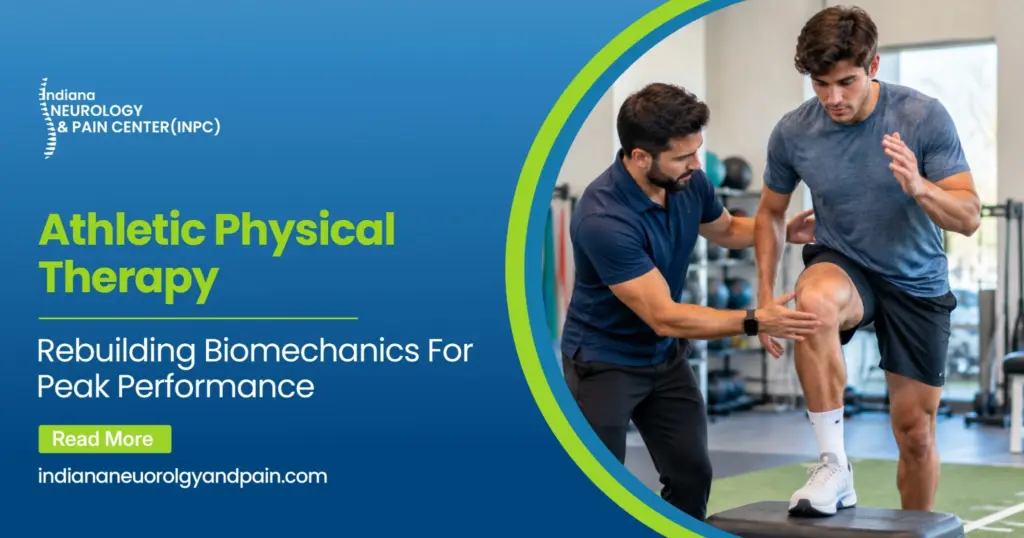
Getting back out there takes much more than waiting for tissue to heal. Standard rest, ice, and generic stretching routines won’t cut it. This is where athletic physical therapy fundamentally changes the recovery trajectory. Rather than simply making the immediate pain stop, this clinical discipline rewires your biomechanics so your body can handle the violent, chaotic loads of live competition. Let’s look closely at how sports rehabilitation actually works, and what it takes to bounce back stronger than before.
Why Standard Rehab Isn’t Enough
If you tear a ligament or blow out a tendon, basic orthopedic physical therapy aims to get you walking up the stairs or carrying groceries without limping. But sports demand something else entirely. Athletes need aggressive acceleration, sudden deceleration, and unpredictable cutting maneuvers. Professional sports therapy bridges the gap between basic daily function and peak athletic performance.
You simply cannot prepare a volleyball player for max-effort jumping by having them do basic leg lifts on a yoga mat. Tissues have to be stressed safely. By applying targeted mechanical loads, therapists force ligaments and tendons to remodel and grow denser over time.
Table 1: Comparing Clinical Benchmarks
| Rehab Benchmark | Traditional Orthopedic Therapy | Professional Sports Therapy |
|---|---|---|
| Discharge Metric | Pain-free daily living (ADLs) | Objective Return-to-Play (RTP) scores |
| Tissue Loading | Low resistance, slow tempo | Heavy eccentric loading, velocity training |
| Movement Focus | Straight-line walking, static balance | Reactive agility, chaotic change-of-direction |
| Clearance Standard | Time-based (e.g., 6 months post-op) | Criterion-based (e.g., 95% Limb Symmetry) |
What Exactly Does an Athletic Physical Therapist Do?
They aren’t just counting reps. They act as biomechanical detectives. When a baseball pitcher complains of nagging elbow pain, the actual culprit might be a stiff thoracic spine or poor hip rotation. Fixing the elbow requires fixing the entire kinetic chain. Athletic physical therapy pays attention to all these minor details and nuances.
During a late-stage session, you might encounter high-speed force plate analysis. This measures exactly how much power you generate—and absorb—when you land. Clinicians look closely for energy leaks. They measure peak torque using isokinetic dynamometry. If your injured leg cannot produce at least 90% of the force that your healthy leg produces, you aren’t ready to return.
Sending an athlete back based on time alone (for example, clearing someone exactly nine months after surgery regardless of strength) is exactly how secondary tears happen. Research indicates that returning before specific strength markers are met dramatically spikes the risk of a second injury, pushing re-injury rates close to 30% for younger athletes. An athletic physical therapist relies on hard data, not the calendar.
Common Injuries Managed by Sports Specialists
The human body is resilient, but the sheer velocity of modern sports creates specific injury patterns. Specialists routinely manage complex orthopedic fallout, including:
- Ligament Tears (ACL, MCL, UCL): The ACL is notoriously vulnerable during sports that demand sudden pivoting. Post-surgical rehab for a torn ACL is a grueling marathon. It requires protecting the fragile surgical graft while aggressively combating quadriceps atrophy.
- Tendinopathies: Achilles tendinopathy or jumper’s knee (patellar tendinopathy) aren’t just simple inflammatory issues. They involve the actual structural degradation of collagen fibers inside the tendon. Rest alone will not fix it. The tendon requires highly specific heavy slow resistance (HSR) and eccentric loading to physically rebuild the tissue matrix.
- Muscle Strains: Hamstring and groin pulls have frustratingly high recurrence rates. Therapy focuses on lengthening the muscle fibers while simultaneously building brutal strength in that lengthened state, improving the tissue’s capacity to absorb force during a sprint.
- Post-Concussion Syndrome: Modern athletic rehabilitation goes far beyond muscles and bones. Sports specialists now heavily incorporate vestibular and ocular rehab. They use complex visual tracking drills and dynamic balance protocols to safely guide concussed athletes through return-to-learn and return-to-play workflows.
The Certification Path in Athletic Physical Therapy
Wondering how to become a physical therapist for sports? The road is grueling. You don’t just graduate and walk onto the sidelines of a professional football team.
Candidates first earn a Doctor of Physical Therapy (DPT) degree. That takes three years of intense post-graduate work focusing heavily on neuroscience, cadaver anatomy, and clinical pathology. After passing the national licensing exam, the most dedicated professionals enter highly competitive sports residencies.
Table 2: The Specialty Pathway
| Career Phase | Expected Timeline | Core Clinical Focus |
|---|---|---|
| Doctoral Degree (DPT) | 3 Years | Advanced anatomy, pharmacology, orthopedics |
| State Licensure | 1 Day (Exam) | Passing the National Physical Therapy Examination |
| Acute Venue Coverage | 100+ Hours | On-field emergency management, concussion screening |
| Specialty Certification | Ongoing | Earning the Sports Certified Specialist (SCS) credential |
Earning the SCS credential from the American Board of Physical Therapy Specialties requires either a formal residency or 2,000 hours of direct sports clinical practice. These clinicians have to know how to stabilize a cervical spine fracture on the turf just as well as they know how to program a complex plyometric progression in the clinic.
The Reality of the Rehab Timeline
Recovering from a major musculoskeletal injury rarely follows a straight line. The process happens in distinct, heavily monitored phases.
Phase 1: Protection and Healing
Early on, the priority is mitigating inflammation and preventing muscle atrophy. Clinicians often use blood flow restriction (BFR) training here. By safely restricting venous blood flow, patients get muscle-building benefits while lifting incredibly light weights. This protects healing surgical grafts while waking up the nervous system.
Phase 2: Motor Control
Pain changes how the human brain talks to muscles. People start limping or hiking a hip just to avoid discomfort. This phase strips away those bad habits. The main focus is normalizing gait and regaining full, active range of motion without compensatory cheating.
Phase 3: Hypertrophy and Strength
This is where the real gym work begins. Heavy, slow resistance training takes over. Tendons only adapt when they are placed under significant mechanical load. You have to build the physical capacity to absorb force before you can ever attempt to run or jump.
Phase 4: Return to Sport (RTP)
Gym strength doesn’t automatically equal field performance. Before final clearance, athletes go through rigorous, exhausting testing. Athletic physical therapy takes every factor into account. Think single-leg triple hops for distance, reactive agility drills, and psychological readiness assessments. Fear actually changes how people move. If an athlete doesn’t completely trust a surgically repaired joint, they subconsciously alter how they land. That hesitation forces the healthy leg to absorb double the impact—frequently leading to a catastrophic tear on the opposite side. To prevent this, specialists use specific psychological tools, like the ACL-RSI scale, to put a hard number on a patient’s mental readiness before ever clearing them to play.
Wrapping It Up
Dr. Samiullah Kundi
Pain medicine & Neurologist
Dr Kundi is a board-certified neurologist with rigorous medical training and pain management expertise. Mr. Kundi has been certified by the American Board of Pain Medicine (ABPM), American Board of Psychiatry and Neurology (ABPN) – Clinical Neurophysiology American Board of Integrative Holistic Medicine (ABIHM), and American Board of Psychiatry and Neurology (ABPN) – Neurology. Dr. Kundi’s vision of serving people with neurological pain has led to the establishment of the Indiana Neurology and Pain Management Centre.
Frequently Asked Questions
Indiana operates under direct access laws for physical therapy. Individuals have the legal right to bypass the physician waiting room and head directly to a physical therapist for an initial evaluation and a specified period of treatment. Still, calling the clinic to verify specific insurance network rules is always a smart initial step, as some strict HMO plans occasionally demand a doctor’s signature for billing purposes.
Absolutely not. The exact same techniques used to rebuild a collegiate sprinter work just as effectively for a weekend warrior, a dedicated CrossFit enthusiast, or a parent who just wants to run a local 5K without their knee flaring up. Performance is entirely relative to your specific active goals.
Subjective feelings often lie. Force plates and hop tests measure exactly how much power a limb can generate and safely absorb. If the injured side remains significantly weaker than the healthy side, the athlete risks a catastrophic secondary injury.
Trainers essentially run the sidelines. They manage pre-game ankle taping, handle immediate triage right on the turf, and stop bleeding. Physical therapists, conversely, operate at the doctoral level. They step in as the lead diagnosticians for complex movement dysfunctions, building out those grueling, month-by-month recovery blueprints necessary to get post-operative athletes fully functional again.
Absolutely. Stopping an injury before a tendon ever actually tears is the entire point of “pre-hab.” Today, proactive biomechanical screening forms the absolute backbone of competitive sports medicine. By identifying muscular imbalances or joint stiffness early on, therapists can fix a weak hip abductor in July and easily prevent an ACL tear in October.
References
Active
Cleveland Clinic. Tendinopathy: What it is, symptoms, causes & treatment. Cleveland Clinic. Updated December 9, 2024.
Cleveland Clinic. What is muscle hypertrophy? Cleveland Clinic. Updated September 29, 2025.