

Disclaimer:
The information provided in this article is for educational and informational purposes only. It is not a substitute for professional medical advice, diagnosis or treatment. Always consult with a qualified healthcare provider, such as a licensed physician or physical therapist, before making any decisions regarding your health, starting a new treatment plan, or modifying an existing one. If you are experiencing acute or chronic pain, seek medical attention immediately.
Medically Reviewed By:
Dr. Samiullah Kundi, MD, Board-Certified Physician
Reviewed Date :
10/07/2026
Published Date :
10/12/2026
Table of Contents
Getting back on your feet after a total joint replacement or a massive stroke is physically exhausting. The simple exertion required to push up out of a low chair can drain a patient’s energy for the entire afternoon. When mobility is compromised to that degree, the idea of getting dressed, walking to a vehicle, navigating a crowded parking lot, and sitting in a hard waiting room isn’t just inconvenient. It’s a massive physiological barrier to recovery.
That specific friction is exactly why individuals and concerned family members type in home physical therapy near me into their search bars. They need the clinical expertise of a specialized rehabilitation facility, but they desperately need it delivered to their living room.
Taking the commute out of the equation changes the entire trajectory of healing. Patients save their physical strength for the actual therapeutic work.
What Actually Happens During a Home Session?
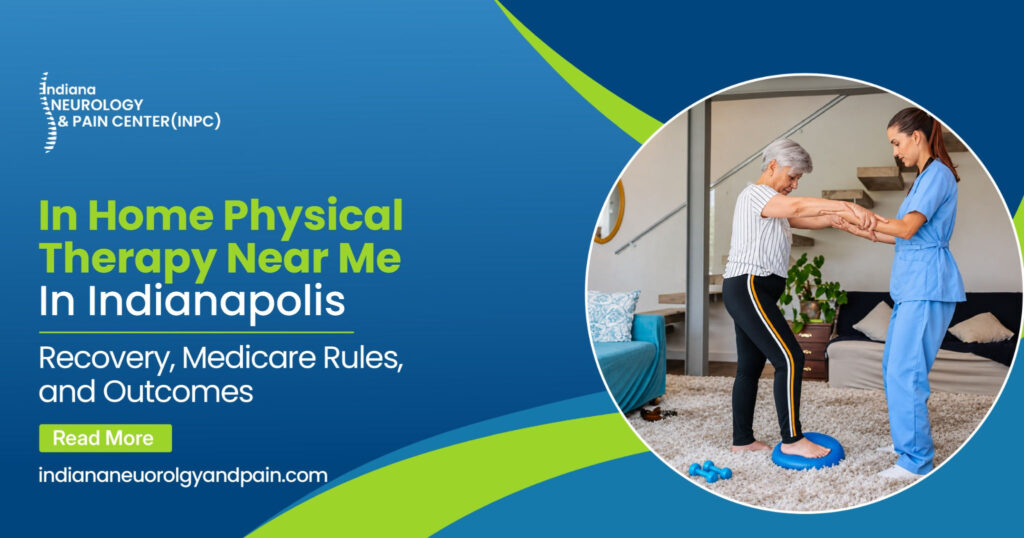
This isn’t about hiring a general caregiver to watch you stretch on the couch. A licensed home health physical therapist is a highly educated medical professional—often holding a Doctorate in Physical Therapy—who brings standard outpatient clinical protocols directly into your personal space.
The clinical objective remains identical to traditional rehab. The provider works aggressively to restore joint range of motion, rebuild atrophied muscle tissue, and eliminate functional pain. The difference lies entirely in the environment.
When patients begin researching in home physical therapy services near me in Indianapolis, they usually envision a medical provider wheeling heavy gym equipment through their front door. That isn’t how the process works. Therapists rely on portable, high-yield clinical tools. They bring specialized resistance bands, goniometers for measuring joint angles, pulse oximeters to track vitals during exertion, and portable TENS units for electrical nerve stimulation.
More importantly, they use your actual environment as the primary gym equipment. Your staircase, your mattress, and your specific bathroom setup dictate the therapy.
Who Requires Home-Based Rehabilitation?
The patient demographic for home care is surprisingly broad. It extends far beyond patients who are permanently bedbound. Patients seeking in home physical rehabilitation generally fall into three distinct clinical categories.
1. Orthopedic Post-Surgical Patients
Someone who just underwent a total knee arthroplasty (TKA) or total hip replacement needs aggressive scar-tissue management within days of hospital discharge. If they had a posterior hip replacement, they have strict “hip precautions”—meaning they cannot cross their legs or sit in a chair that forces their hips to bend past 90 degrees. A home therapist actively measures the patient’s actual furniture to ensure they don’t accidentally dislocate their new joint. Furthermore, driving immediately post-op is medically and legally impossible for these patients.
2. Neurological Recovery
People managing progressive disorders like Parkinson’s disease, multiple sclerosis, or recovering from a cerebrovascular accident (stroke) face massive balance deficits. Learning how to walk safely across a sterile, perfectly flat clinic floor is helpful. However, learning how to safely transition from a plush living room carpet to a slippery kitchen tile floor is essential. Home physiotherapy focuses on neuroplasticity and real-world obstacle navigation.
3. Cardiopulmonary and High Fall-Risk Patients
Patients suffering from severe COPD exacerbations or recovering from a heart bypass fatigue instantly. Sending them out into the community for rehab exposes them to respiratory infections and massive physical exhaustion. Keeping them at home allows for tightly monitored, low-impact endurance training.
Table 1: The Outpatient Clinic vs. The Home Environment
Here is how the two rehabilitation settings fundamentally differ in actual practice.
| Clinical Factor | Standard Outpatient Facility | The Home Rehab Setting |
|---|---|---|
| Environmental Reality | Highly controlled. Level floors, standardized practice stairs, heavy machinery. | Completely customized. Patients train on their actual stairs, driveways, and shower thresholds. |
| Infection Exposure | Shared space. Multiple patients utilize the same parallel bars and waiting room chairs. | Isolated. Therapists sanitize mobile gear before entering, drastically lowering exposure risks. |
| Therapist Attention | Staggered care. A single provider may bounce between two or three patients simultaneously. | Total focus. The clinician remains entirely one-on-one with the patient for the full session. |
| Caregiver Integration | Family members sit in the waiting room, disconnected from the actual session mechanics. | Spouses and caregivers are actively trained in the living room on safe physical transfer techniques. |
The Mechanics of Home-Based Care
The initial visit always centers on an aggressive, comprehensive evaluation. The therapist reviews surgical notes, checks resting vitals, and tests baseline functional strength. But in a home setting, they do something extra: an environmental safety audit.
Therapists actively hunt for trip hazards. A bunched-up throw rug. A poorly placed extension cord. A favorite armchair that sits way too low to the ground. Fixing these environmental triggers instantly reduces the chance of a secondary fall and a subsequent hospital readmission.
Once the safety baseline is established, the physical work begins. Treatment plans usually dictate visits ranging from one to three times a week. Sessions focus heavily on gait training (teaching a patient how to walk properly with a new cane or walker) and neuromuscular re-education. Providers also utilize manual therapy. This involves the therapist applying hands-on soft tissue massage and joint mobilization to relieve acute pain and manually break down stiff surgical scars that restrict movement.
Navigating Medicare and Insurance with In Home Physical Therapy Near Me
Insurance paperwork causes massive headaches for families trying to arrange home health care physical therapy. The confusion usually stems from the fact that Medicare covers therapy at home under two entirely separate, distinct pathways. Knowing the difference stops surprise billing.
Table 2: Medicare Part A vs. Part B for Home Therapy
| Coverage Metric | Medicare Part A (Home Health Benefit) | Medicare Part B (Outpatient at Home) |
|---|---|---|
| The Core Requirement | The patient must be legally certified as “homebound” by a referring physician. | No homebound requirement whatsoever. |
| Who Provides Care? | A Medicare-certified Home Health Agency (HHA). | A licensed mobile outpatient physical therapy practice. |
| Patient Cost | Typically $0 out-of-pocket for covered services. | 20% coinsurance plus the annual Part B deductible. |
| Clinical Focus | Short-term acute recovery, usually immediately following a hospital or skilled nursing stay. | Chronic condition management or ongoing injury rehab for highly mobile patients. |
The word “homebound” trips up many families. It does not mean the patient is literally chained to their bed. Medicare defines homebound as a condition where leaving the house requires “taxing effort.” If a patient requires a walker, a wheelchair, or the physical assistance of another human being to get out the front door, they usually qualify. Patients can still leave the house for medical appointments, religious services, or trips to the barber without losing their official homebound status under Part A guidelines.
Another major administrative hurdle is the “Face-to-Face” requirement. To trigger Part A home health benefits, a physician must have physically or virtually evaluated the patient specifically for the condition requiring therapy within 90 days before care starts, or within 30 days after.
Caregiver Burden and Transfer Training
Rehabilitation does not happen in a vacuum. A severe mobility deficit impacts the entire household. One of the least discussed but most vital benefits of home therapy is direct caregiver training.
When a spouse tries to help a patient out of a low bed without knowing proper transfer mechanics, that spouse inevitably suffers a severe lower back injury. Therapists stop this cycle. They teach family members exactly how to securely grip a gait belt. They demonstrate exactly where to stand when the patient is navigating a staircase. This hands-on education protects the patient from falling and protects the family member from accidental orthopedic injury.

Dr. Samiullah Kundi
Pain medicine & Neurologist
Dr Kundi is a board-certified neurologist with rigorous medical training and pain management expertise. Mr. Kundi has been certified by the American Board of Pain Medicine (ABPM), American Board of Psychiatry and Neurology (ABPN) – Clinical Neurophysiology American Board of Integrative Holistic Medicine (ABIHM), and American Board of Psychiatry and Neurology (ABPN) – Neurology. Dr. Kundi’s vision of serving people with neurological pain has led to the establishment of the Indiana Neurology and Pain Management Centre.
Finding the Right Path Forward
Frequently Asked Questions
Most of the time, yes. Even if your specific state operates under “Direct Access” laws—which allow physical therapists to evaluate patients without a prescription—major insurance companies and Medicare absolutely require a physician-signed Plan of Care before they will authorize claim payments.
No. You do not need to build a home gym. The clinician brings everything required for the medical session. They may recommend purchasing cheap, accessible items like resistance bands or a foam balance pad for your daily homework exercises, but heavy machinery is never required for effective treatment.
Expect the clinician to be in your home for 45 to 60 minutes. The very first visit (the evaluation) might take slightly longer due to the heavy paperwork, medical history reconciliation, and the mandatory environmental safety audit.
Patients graduate. Once baseline strength improves and traveling is no longer a physically taxing effort, the home therapist safely discharges the patient. If the individual still requires higher-level strength training—like returning to heavy lifting, running, or a demanding sport—they seamlessly transition to a traditional outpatient clinic to finish the final stages of recovery.
References
Active